

We Are All Diné
To inhabit a place, from the West Elks to Canyon de Chelly, and beyond

“The first step in wisdom is to know the things themselves…. objects are distinguished and known by classifying them methodically and giving them appropriate names.” Carolus Linneus in Systema Naturae, 1735
“Tis but thy name that is my enemy…. O, be some other name” William Shakespeare, Romeo and Juliet, 1597
The phrase, “We are all Diné” has been an earworm crawling through my brain since our Navajo guide to Canyon de Chelly uttered it.
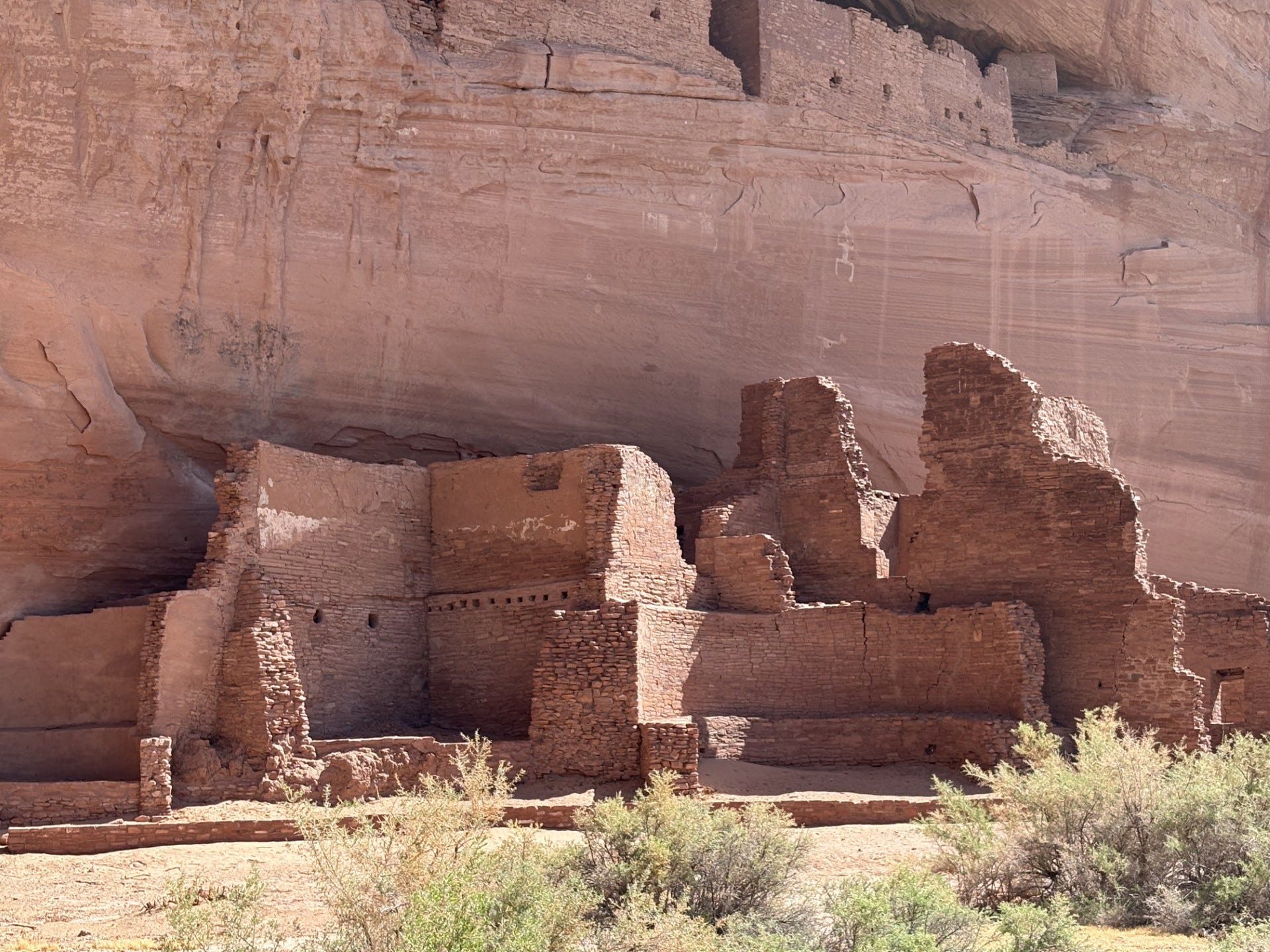
During my time at RMBL one of the issues was whether the forcible removal of the Utes from our landscape ~150 years ago should change current scientists’ relationship to the landscape. How should the sins of the past be reflected today? We improved how we told that history, but should RMBL “give the land back” as suggested? Learning Canyon de Chelly’s history provided a nuanced perspective on history, identity, culture, and the cross-generational relationships between community and place.


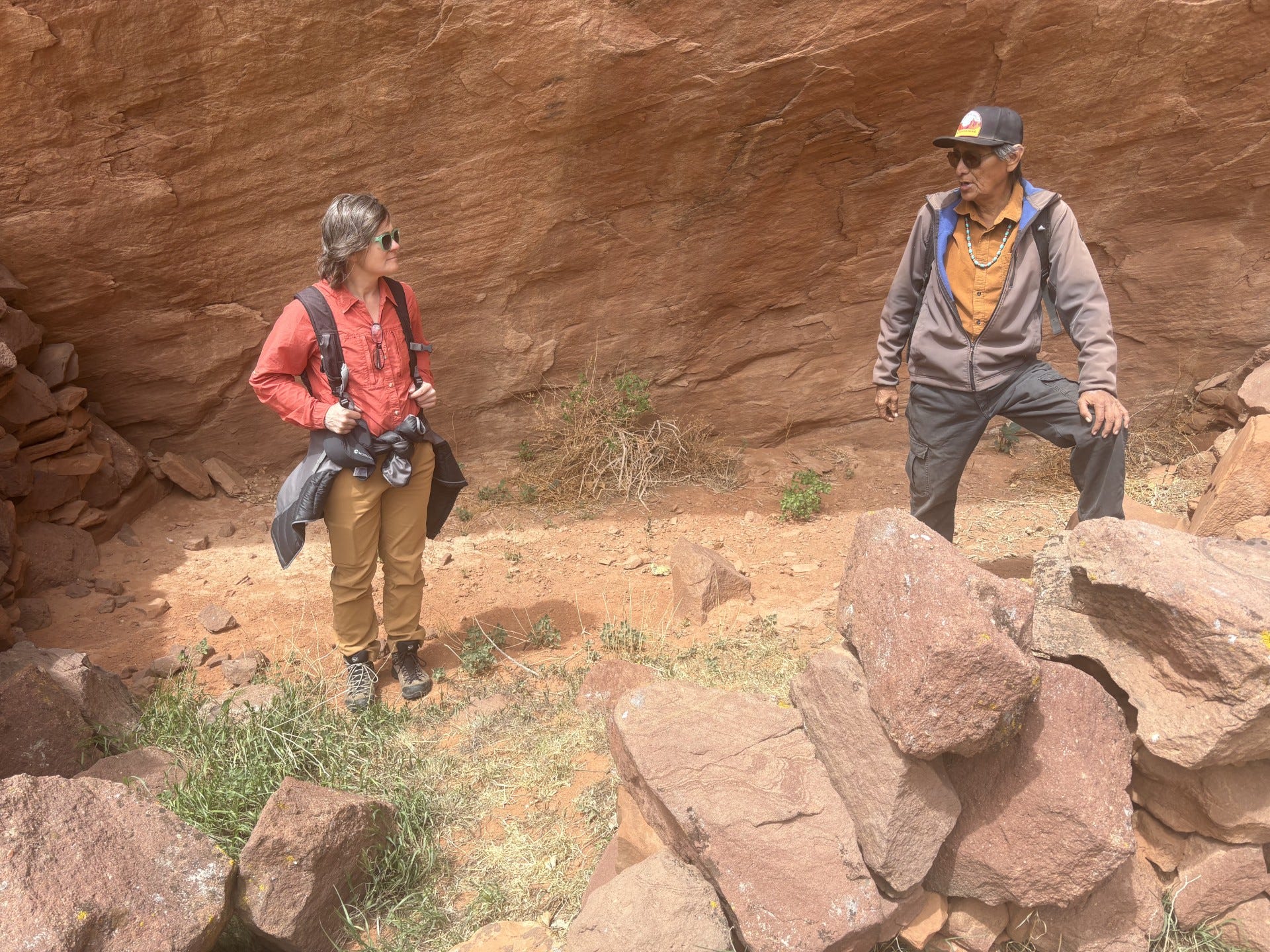
We were guided by a canyon resident whose grandfathers inhabited the canyon and had also been professional guides. His family shares the canyon with visitors, the smell and taste of water on the desert floor, the feeling of the shadows stealing the warmth of the early afternoon sun, the sound of wind dancing off cliff faces, and the antelopes, stick figures, and clan symbols carved in rock along cliff dwellings nestled amidst soaring red, orange, and pink canyon walls sculpted by wind and water.
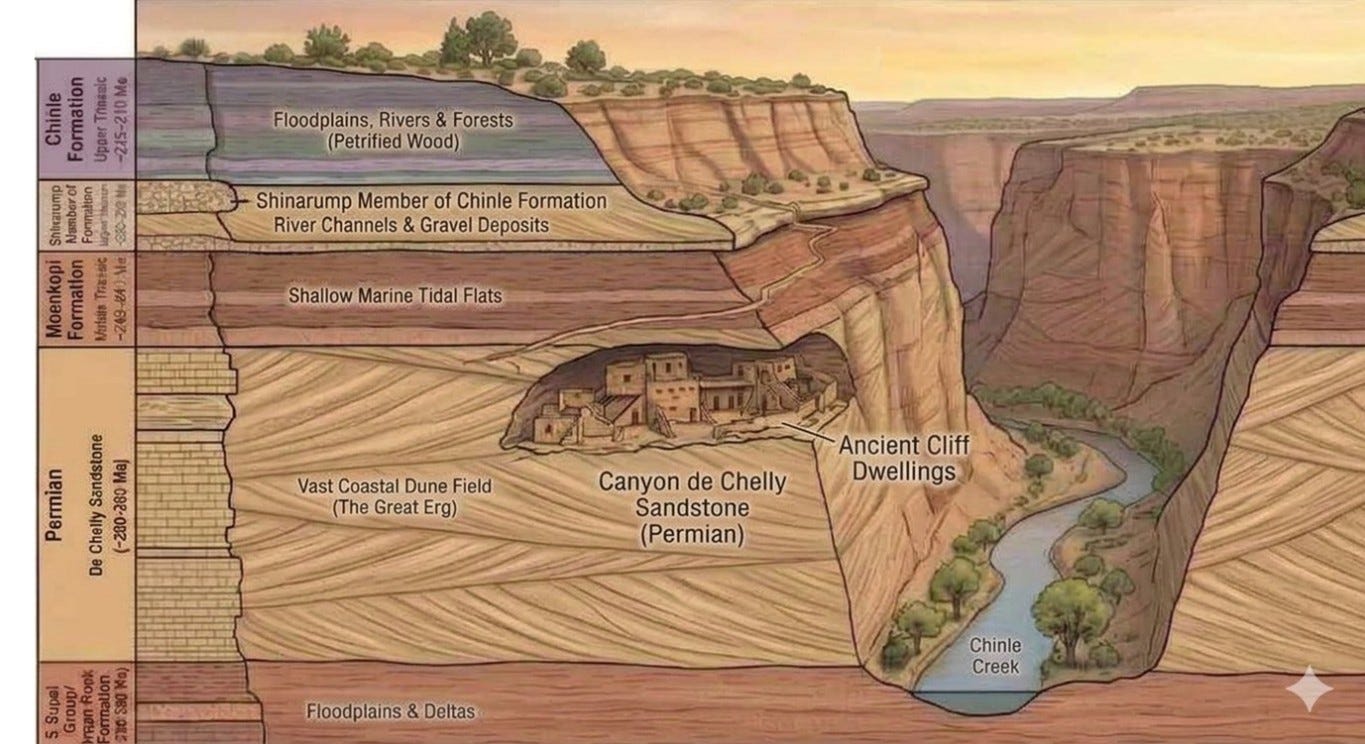
Evidence of humans wandering the canyon dates back 5,000 years, starting with the “Archaic” hunters and gatherers. Around 200 BC the “Basketmakers” started farming and creating permanent habitations. The striking cliff dwellings started in 750 AD, as they did across the plateau, ultimately to be largely abandoned in ~1300 AD during intense drought, though the Hopi continued to visit.
Archeologists initially considered the abandonment of the Colorado Plateau cliff dwellings a mystery, believing that an ancient people, the Anasazi (Navajo for ancient enemy) had disappeared, despite Puebloan communities explaining their grandfathers had moved elsewhere. As archeological evidence mounted for continuity between the ancient cliff dwellings and the modern Pueblo communities, “ancestral Puebloans” replaced “Anasazi”. Navajo tradition describes their arrival in Canyon de Chelly, a sacred Navajo landscape, shortly after the ancestral Puebloans left, if not earlier. Tree rings from structures suggest heavy habitation by the Navajo of Canyon de Chelly starting ~1700 AD.
The Navajo were expelled from Canyon de Chelly during the US-Navajo wars. American settlers flooded the southwest following the 1848 resolution of the Mexican-US war, bringing conflict to the Navajo, who were ordered in 1863 to the Bosque Redondo reservation in eastern New Mexico. Kit Carson, along with US and Ute soldiers, raided Canyon de Chelly to enforce the order, only to be stymied by ~300 Navajo, including elderly and children, who scaled Fortress Rock, pulling up ponderosa pine ladders behind them.


Ultimately a negotiated settlement sent the Canyon de Chelly holdouts, along with ~10,000 other Navajo, to Bosque Redondo. A tragedy for the Navajo and a failure for the US, in 1868 Navajo leader Barboncito negotiated a return to their sacred lands, including Canyon de Chelly.
As part of recounting this history, our guide said his grandma had warned him about names. “Better to describe. To name is to divide”. Interestingly, “Navajo” comes from the Tewa linguistic branch associated with the eastern Pueblos, meaning place of large, planted fields. Indeed, the guide had introduced himself by listing his four clans, which embedded him in a historical and social network. For example, a person listing the Coyote Pass Clan is rooted in a clan that emerged at the end of the Pueblo Revolt (1696) when members of the Jemez Pueblo moved west, integrating into the Navajo.
Names can be a problem, even in science. As an example, to be mammal, unlike (mostly) birds and reptiles, is to have a placenta, which emerged from the integration of viral genes into mammalian genomes, something that happened not once, but multiple times. Species names were straightforward when we thought evolution was a matter of emerging, discrete branches. But now we realize evolution is more like a series of rivers, gene lineages that weave in and out, merging, separating, and merging again. Indeed, half the cells in our bodies are bacteria, fungi, and other little things that are fundamental to who we are. Your grandfathers are not just human and primate; they are also viral and fungal. The concept of “Ian Billick, Homo sapiens” has utility but it can also obscure.
Human culture, including languages, building styles, tools, and art, also interbraids. Tool development can flow gently before getting dammed up and stuck, only for a burst of innovation to flood the landscape. Language might flow with the tools, only to separate before merging again. Archeologists might describe an entire period of people based on the buildings and pottery they leave behind, but only because the details have disappeared into the mists of time.
What does this complexity mean for the relationship between a people and a place?
Ownership is not disappearing anytime soon, but maybe we should focus on who inhabits, loves, and stewards a place, including whose people bury there. There are many ways we can extend grace, actively opening our arms to those forcibly removed in ways that are meaningful to them. We can also, appropriately and with balance (though not necessarily easy), welcome visitors. Fundamentally, we can start building relationships with landscapes and the people within them, moving beyond disembodied transactional experiences treating places and people as slot machines whose primary purpose is to light up dopamine receptors.
The Navajo refer to themselves as “Diné”, which means “the people”. “We are all the Diné—the Navajo, the Puebloans, you, everybody.” And with these words ringing in my head I returned to my place, the West Elks. If you, too, would like to visit Canyon de Chelly, I highly recommend Adam Teller with Antelope House Tours.
Thanks for waiting a bit for this column. I’m sad, and relieved, to announce the passing of my father, Jim Billick (July 19, 1941 - April 29, 2026) after a period of advanced dementia. We will be celebrating Jim’s life in KC on May 23 and laying his ashes at the family graveyard in Savannah, OH Oct. 17. If you would like to join us, please reach out.
From ethnographical research on the Navajo use of names: “Son of…That’s a real hard word to live by. You have to respect yourself. You have to kinda go to whatever teachings your father has, whatever disciplines that he stresses, to a point where he would appreciate you. So that’s what biye’ means.”
Thank you, Dad, for the helping me be “son of”.
Beautiful essay, Ian.........