

Sublime Madness
Local Climate Action in the Age of “Drill Baby Drill”

“It is one of the happy incidents of the federal system that a single courageous State may, if its citizens choose, serve as a laboratory; and try novel social and economic experiments without risk to the rest of the country. …. we must let our minds be bold”.
Supreme Court Justice Louis Brandeis in New State Ice Co. v. Liebmann (1932), arguing for the power of unleashing innovation in local policy.
What does it mean to be a climate-active, small-town Mayor in the context of a federal government whose energy policy is best summarized as “drill, baby, drill”, a government pulling out of the 1992 United Nations Framework Convention on Climate Change? Is local action just a feel-good thing, with decision-makers in Beijing, Washinton DC, and New Delhi rendering most of the globe’s ~4 million cities and towns with small populations irrelevant?
As a liberal community whose economy depends upon climate- dependent snow and wildflowers, we lean towards local action. But do we matter?
A long, long time ago, in 2023, the Town of Crested Butte created waves by requiring electrification of new construction. The first Colorado municipality to take this step, national media called. Atmos Energy sent a senior official to sit on a porch in Gothic to explain the importance of natural gas.
Leading up to the decision, ~60 members of the public filled the council chambers, a refurbished grade-school classroom. I sat at a table in the front of the room, with three council members on each side, armed with an undersized gavel. The attending local builders were largely, though not wholly, in support and described cost-effective electrified homes they had built. Climate activists emphasized the urgency of action.
The energy representative touted a zero-emissions model home heated by natural gas. When pressed to explain such a carboniferous miracle, he agreed it was a good question, but pleaded ignorance as to the details. At home, my son, pulling on high school physics, suggested the building must have emissions offset by reductions elsewhere, an answer confirmed by the internet and thermodynamics. A conservative sat in the audience, muttering personal insults, either not realizing or caring how words travel in small communities.
With the support of the community, including experienced engineers and builders, the council mulled things over.
Affordability: Concerns were alleviated by the experiences of local builders. Technology has put electrical costs on par with natural gas and not having to natural gas infrastructure further tilts the cost/benefits.
Capacity: The electric company assured us electrification would not overload the system.
Carbon-emissions reductions: Electricity is clean and getting cleaner; 50% of our 2025 electricity was from renewables, rising to 70% in 2030. Unfortunately, natural gas is not as clean as it could be. Methane leaks from pipelines means natural gas emissions are similar to coal.
Redundancy: While there was anxiety over a lack of natural gas back-up during electrical outages, new natural gas heating systems require electricity to work. The council later relaxed restrictions on wood-burning stoves.
Choice: Natural gas companies arguing choice felt cynical. I’ve never had a choice about gas or electrical heating and often builders don’t either; many states ban electrification. A neighboring municipality initially rejected electrification of a new development. When climate activists protested, an elected official expounded on the importance of choice. When informed that the Town was requiring natural gas, his response was, “But I like natural gas!”.
True to polls indicating widespread support for climate action, electrification generated no political backlash. Council members ran unopposed in the next election cycle.
CB’s climate action did not stop with electrification. We provided land for our energy coop to build a megawatt solar farm. Ensuring new developments, such as the Whetstone housing project, are well-served by mass transit saves money and reduces parking pressures while reducing emissions. We subsidize energy efficiency improvements in workforce housing.
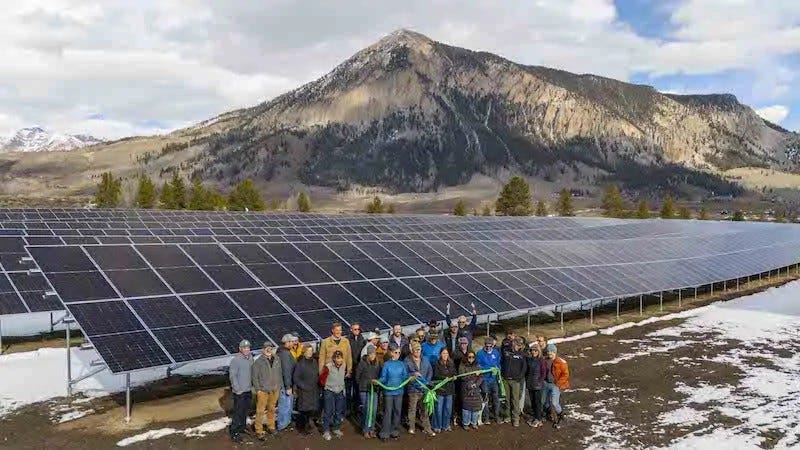
More generally, towns and cities account for ~70% of global emissions and are critical to climate action. We set building codes, which determine building efficiency, and drive land use, which impacts how and where people travel. However, while Crested Butte is not even a dimple on an elephant, our value is in lessons learned.
As Mayor, I’ll point to a few things.
People are not in the mood for higher costs and/or wasted money. This means focusing on high impact actions that don’t hit the pocketbook hard. Some people don’t like emphasizing emissions reduced per dollar, but if the point is to reduce our emissions, and money spent on one item is not spent elsewhere, arbitrary action creates a credibility problem.
Policy has to work. Just because technology exists doesn’t mean there are architects and builders that know how to use it. Right now, complicated control systems to keep air source heat pumps working at -10 F aren’t working well. Given that we can air condition Las Vegas I’m sure we can heat Crested Butte. But our credibility, and capacity to drive future policy, disappears if we don’t deliver.
With emerging technology, timing is critical. Smaller electric vehicles, like police cars, are cost effective. However, larger electric vehicles, like plows, front loaders, and buses are still expensive. If we move too fast, we could waste a lot of money.
Evaluating what is working is important. There are a lot of assertions on both sides about the costs of electrification; we’ll evaluate how our energy-efficient building code with electrification requirements impacts construction costs and operations of Mineral Point, an affordable housing project opening this year.
I’ll also give credit to Crested Butte’s unusual values-based approach to decision-making. We committed to a legacy created 50 years ago when the community rejected mining, an approach that put our economy in service of our values, rather than vice versa. We committed to authenticity, boldness, connectedness, and accountability in our decision-making, an approach that has freed us to emphasize values. Being bold, yet pragmatic in our accountability with a willingness to learn from our mistakes, freed us from the tyranny of searching for the perfect policy decision and opens the council us to reasonable risks. If our leaders won’t act on our values, who will?
Finally, we have to engage our community, including builders, architects, and owners of new properties. For these policies to not just stick, but spread, we can’t rely upon top-down mandates. Rather, we will have to build widespread support with wise decisions and effective action.
What we do, and how we do it, matters!
Excellent commentary! Crested Butte has always been at the forefront of environmental issues….it’s called leadership. Nice job!
“Waiting for the percent” is a frustrating phenomenon, particularly in wealthy areas. It’s observed and justified frequently in communities like ours and often is the enemy of progress.