

Silicon
A molecular toolbox for price-sensitive, earthbound demigods

“Prometheus stole fire from the gods and gave it to man. For this he was chained to a rock and tortured for eternity.” Opening line from Oppenheimer, Christopher Nolan’s 2023 film about Robert Oppenheimer and the creation of the atomic bomb.
Starting with Prometheus stealing fire, humans have aspired to the tools of gods.
With an incessant desire to alter our environment for food, larger families, comfort, and social media attention, we have long appreciated the value of energy, innovating numerous ways to make things happen, from water wheels; to oil from birds, whales, and fossils; to photovoltaic panels.
Our recognition of the importance of encoding and manipulating information has been more recent. Writing emerged 5,000 years ago, but Johannes Gutenburg’s movable type printing press of 1440 replicated encoded information at scales beyond the capacity of monks toiling in medieval scriptoriums. Four hundred years later Charles Babbage mechanically manipulated and analyzed encoded data, followed by the first programmable, electromechanical computer in 1937, a gift, appropriately, from Zuse. Embedding microprocessors in everything from appliances to clothes took off with the Bell Lab’s invention 10 years later of the transistor, a diminishingly small and ever-cheaper device for managing information and energy.
Tools to manage information and energy are fundamental to our desire to control a universe ravaged by growing disorder and chaos. Encoded information allows us to discover and propagate recipes for order and predictability, while energy enables imposition of that order upon the universe. Energy and information are different sides of the entropic coin, a relationship we are still untangling.
Our modern toolbox is built around the manipulation of electrons, subatomic particles probabilistically surfing around nuclei. Like marbles rolling downhill, free electrons fill available holes in orbital shells, taking first the hole most tightly bound (e.g., close) to the nucleus. The distance of this hole from the nucleus, and to the next available hole, determines how easy it is to move an electron and whether an element is an insulator, conductor, or something in between. Controlling electron movement gives us energy in the form electromagnetism and can be used to encode information.
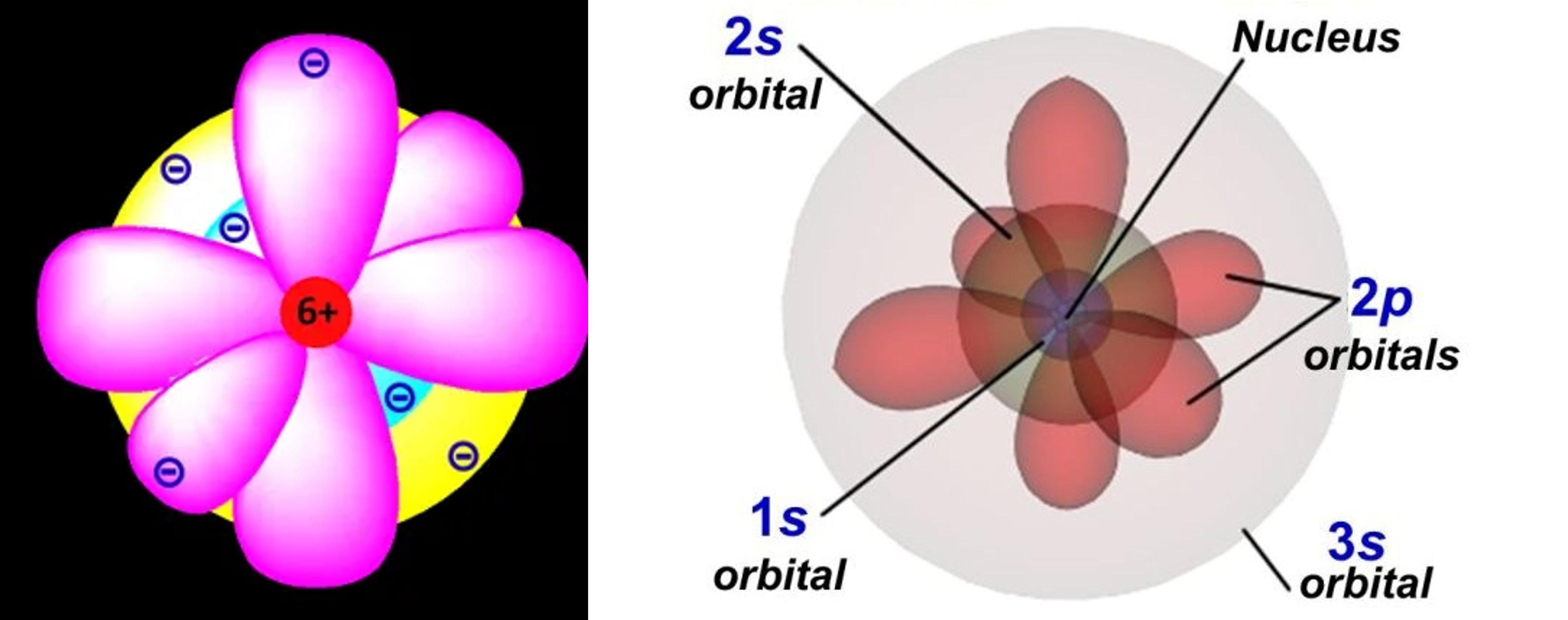
Life only became possible with the emergence of a carbon-based toolbox for managing electrons. The location of electron holes is important to molecule creation, since one electron can fill holes for two atoms simultaneously, creating bonded atoms, or molecules. Carbon’s outer, with 4 electrons and 4 holes, creates bonds with many other elements and since the electrons and holes are relatively close to the nucleus in the second shell, the bonds are strong, creating stable molecules. Evolution, in all her wisdom, chose carbon upon which to build her toolbox.
Humans turned to silicon. Silicon is a goldilocks conductor, or a semi-conductor. With 14 electrons compared to carbon’s 6, silicon’s second orbital shell is full, leaving 4 electrons and lots of holes in the third shell. Because its outer electrons are further from the nucleus, they are less tightly bound than in carbon, making silicon molecules less stable. But compared to carbon, less energy is needed to move an electron, making silicon an efficient choice for controlled electron movement. We use silicon in solar panels to create directional electron flow, or electricity, and to build transistors that hold binary information in the form of gates which are open or closed to the flow of electrons.
While carbon is more common away from gravitational anomalies such as black holes and planets, silicon is more abundant on earth. Smaller and therefore more easily formed, when a star’s heart reaches 100 million degrees nuclear fusion causes helium nuclei to fuse and scavenge free electrons. Silicon requires higher temperatures generated by the deaths of massive stars to reach 14 electrons. But whereas silicon combines with oxygen to form solid silica (e.g., sand and quartz), carbon combines with oxygen to form carbon dioxide and other gases that are easily lost to gravity. Consequently, silicon makes up a quarter of the earth’s crust, while carbon is <1%.

Silicon may be more common on earth, but the carbon toolbox, with evolution’s 4-billion-year head start, is more elegant. Like a German race car, life’s information molecule, DNA, is highly engineered, with each atom having a carefully designed role. A DNA base pair is 0.34 nanometers (nm) long and 2 nm wide, with 4 possible states (guanine, adenine, thymine, and cytosine). With double strands, it has built-in redundancy. By contrast, the smallest working transistors are currently ~2 nm x 2 nm, hold two possible states (open and closed), and lack internal redundancy. In contrast to DNA, transistors are a hodge-podge, with “dopants” necessary to juice the flow of electrons or holes haphazardly dropped in. Quantum uncertainty, with electrons “tunneling” across insulators, challenge our control of electron movements at DNA-like scales.
Whereas humans primarily rely upon silicon wafers to capture the sun’s energy, the carbon toolbox has an elegant and diverse array of molecules to manage energy, including chlorophyll for capturing energy from the sun and mitochondria for converting food to energy. The carbon toolbox incorporates quantum uncertainty as a feature, not a bug, in managing electron movement. Life’s fundamental energy unit, adenosine triphosphate (ATP), is about 1 nm in size, orders of magnitude smaller than the smallest human battery.
If the Greek titan Prometheus was condemned to an eternity of torment for giving fire to humans, what does the creation of our silicon toolbox mean for humans, however crude? Until we create generative intelligence, silicon beings driven to replicate themselves, capable of identifying and solving problems in novel ways, we will be more demigods than gods. But while traditional transistors are reaching physical limits in size, quantum computing and the elegance of life’s carbon toolbox suggests we can continue our ascent to the sun, increasing our capacity to push back the entropic tides.
Will this journey deliver torment, leisure, or fulfillment?
Just as the Titans gave birth to the Olympian gods only to be banished to the deep, dark pit of Tartarus, are we giving birth to our replacements, as suggested by stock market gains predicated upon computers replacing humans? Perhaps we should settle for demigod status as we learn how harness our emerging powers.
To learn more about the amazing technology that has allowed transistors to steadily get smaller, making our computers evermore powerful, check out this video. Thanks to Jeff Delaney and Amy Ellwein for geological assistance and Philippe Cohen for his photography!
Loved this! Really cool insight!!!
This was brilliant and showed an understanding of the story and role of current technological knowledge.